linux kernel cves by fix author, 2026
on this page
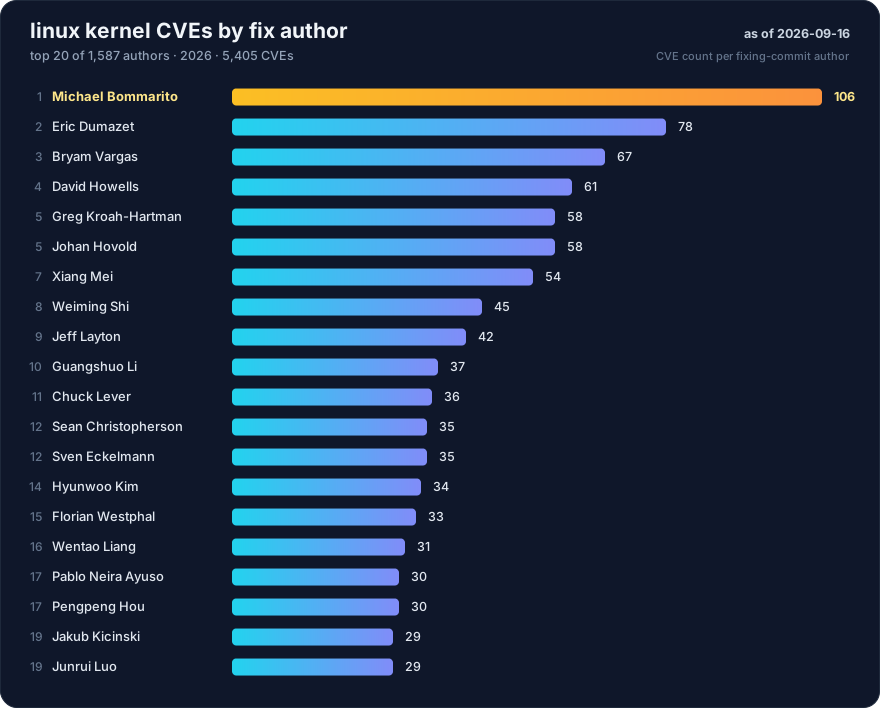
top 20 of 1,853 authors, ranked by the number of 2026 linux kernel CVEs whose fix they wrote. data as of 2026-09-25.
the ranking (top 20)
| rank | CVEs | author |
|---|---|---|
| 1 | 117 | Michael Bommarito |
| 2 | 92 | Eric Dumazet |
| 3 | 72 | Bryam Vargas |
| 4 | 68 | David Howells |
| 5 | 61 | Xiang Mei |
| 6 | 60 | Johan Hovold |
| 7 | 58 | Greg Kroah-Hartman |
| 8 | 55 | Weiming Shi |
| 9 | 49 | Pengpeng Hou |
| 10 | 44 | Guangshuo Li |
| 10 | 44 | Jeff Layton |
| 12 | 43 | Namjae Jeon |
| 13 | 40 | Fan Wu |
| 13 | 40 | Sven Eckelmann |
| 15 | 37 | Chuck Lever |
| 15 | 37 | Jamal Hadi Salim |
| 15 | 37 | Sean Christopherson |
| 18 | 36 | Florian Westphal |
| 18 | 36 | Jakub Kicinski |
| 20 | 35 | Hyunwoo Kim |
that’s the top 20; the full ranking of all 1,853 authors is in the data files below.
the result
the linux kernel issues a CVE for nearly every bug fix that gets a stable tag, and each CVE points at the commit that fixed it. across the 6,885 2026 CVEs i could resolve to a fix author (1,853 distinct authors), i wrote the fixing commit for 117, first by 25.
how it’s counted
a CVE goes to the author of its mainline fix commit, read from the git author header. resolution is object-addressed with git cat-file, not git log --author, so backported fixes that never touched the local branch tip still count. one CVE, one author.
this counts who wrote the fix. a bug you reported but a maintainer patched credits the maintainer, so 117 is an authored-fix floor, not a ceiling. author and fix SHA are ground truth; the CVSS fields in the data are indicative only, since the kernel CNA assigns no CVSS. a severity-weighted view is unreliable on this corpus (43% coverage, floor-censored at 7.0), and i’ll cover that in a separate write-up rather than muddy the count here.
the data
authors-2026.csv— the frequency table, all 1,853 rows, with the indicative severity mix and finding-credit columns (reported-by / suggested-by / co-developed-by / tested-by, counted on other authors’ fixes and never ranked).authors-2026.json— the same, plus each author’s CVE-id list.cves-2026.csv— per-CVE attribution: author, fix SHA, subject, and links to NVD and the kernel commit.leaderboard-2026.json— everything, plus agenerated_utctimestamp and full provenance.
each build also writes MANIFEST-2026.json (byte size + sha256 per artifact) and a compact timestamped copy under snapshots/.
reproduce it
the generator is one self-contained python file, standard library plus git, no local paths baked in. clone the kernel CNA data and a kernel tree, then:
git clone https://git.kernel.org/pub/scm/linux/security/vulns.git
git clone --filter=blob:none https://git.kernel.org/pub/scm/linux/kernel/git/stable/linux.git

python3 build_leaderboard.py --year 2026 \
    --corpus vulns/cve/published --tree linux
it records which tree resolved each object and the tree HEADs it ran against, so a rerun on the same corpus reproduces the table exactly. the exact generator for this run is downloadable: build_leaderboard.py (MIT, standard library plus git).
see also
- glaurung windows driver findings — the same calibration discipline on windows kernel drivers.