Wednesday in the Woods · episode 008
What is it worth?
10:23youtube · Licensio, LLC
description
“What is something #worth?” ⚖️📈💸
Do you ever feel like you’re in the dark when it comes to answering this #valuation question? Does it seem like we’re grasping at shadows on a cave wall, struggling to connect the form of an asset's #price with the substance of its value? And what if the asset is #software or #data?
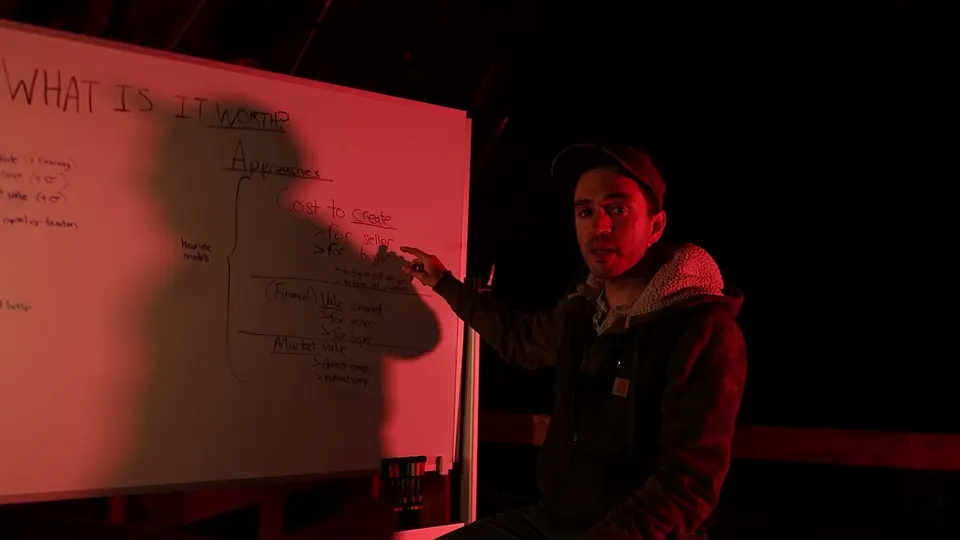
Well, then today’s Tuesday recording of #WednesdayInTheWoods, live from the #LearningLoft, is right up your alley. We cover three approaches to understand the “worth” of something.
In each of these contexts, it’s important to remember that worth is “in the eye of the beholder” like a seller or buyer.
To understand approaches based on cost, it helps to start with a few basic questions about an asset:
☑️ How much did the seller originally spend to produce it (R&D, setup, etc.)? ☑️ How much would the seller spend to create it today (using know-how and assets)? ☑️ How much would a specific potential buyer spend to do it all over?
A good cost accounting system can be a huge help to answering these questions, but there are always missing pieces. Further, costs like labor and energy can change over time, across regions, or for organizations with different sizes or cultures. Which costs are the right one to use?
The financial value approach is what you’d expect from a first-year MBA course: ☑️ How much revenue is the asset generating for the seller? ☑️ How much expense is the seller currently avoiding due to the asset? ☑️ How would these answers change if the seller were to hypothetically change its activities? (scaling marketing or a synergistic service line) ☑️ How would a specific potential buyer answer these questions?
Many of these questions come back to a discounted present value of cashflows. But whose discount rate or cost of capital applies in which currencies? As above, if you shift the people, process, and technology across firms, do input costs or output values change?
The third approach we cover today is focused on market-observed prices. Understanding value with market prices often comes down to two questions: ☑️ Is there a directly-comparable asset that has observable prices? ☑️ Is there a population of indirectly-comparable assets with observable prices?
When assets have direct “comps,” we can often use single transactions or simple averages as a mark. However, in most interesting cases, only indirect “comps” are available.
These situations require parties to: ☑️ Collect data for these indirect comps - data model required! ☑️ Develop a model for explaining the observed prices of these comps ☑️ Use the model to set a mark for the asset of interest
If it feels like these frameworks are based on real property like buildings or cars, well...that’s because they are. If you wonder whether there might be better approaches to valuing intangible property - especially things like software and data - well, you’re not alone.
Stay tuned!
transcript
~1,201 words · showhide
from the human-edited captions published with the video. timestamps jump to that point in the video.
- 0:40
Good evening and welcome to this Tuesday recording of Wednesday in the Woods in the Learning Loft. Today, we're gonna be talking about how to understand worth. We want to answer the question, what is something in particular an asset worth. And to do that, we're gonna look at three different frames or approaches that are commonly used. The first is to understand the costs to create something. It's important to remember that in valuation and when asking about something's worth, it's always, as they say, in the eye of the beholder - it's relativistic.
- 1:19
So, a seller may have at some point in the past incurred some costs to create an asset. Those costs may have included research and development. They may have included some initial setup of some production capability and they may include any kind of marginal cost per unit, such as raw materials or labor. Those analogies seem like they're focused on physical asset production, but in many ways, the analogy carries through to the development of things like software and data as well.
- 1:52
The buyer may or may not have a similar experience. So, if a seller spent $1 million dollars developing a product and bringing that product to market through the capability of producing something like software, then the buyer may or may not be able to do that for $1 million. If the buyer is larger and more efficient and has access to more sophisticated research and design and more efficient developers, then perhaps the buyer could create the same piece of software for less.
- 2:29
On the other hand, the buyer may struggle to understand the design of the asset. It may take them some time in research and development. Trial and error may extend for a long period introducing not just financial issues, but timeline risk. The seller has already incurred that research and development costs it's known, whereas the buyer needs to make a decision based on an estimate of the cost to designer and research a product.
- 2:57
Similarly, even if the the potential buyer of an asset understands the designer has access to a design, they may not have the capability of producing it for reasons that include scarcity of resources or lack of technical know-how. The next approach to understanding worth has to do with financial value created. So, a seller with an asset today may be using that asset to create some kind of cash flow or to reduce another expense.
- 3:32
In one case, the seller may be licensing a product like a piece of software or data. In other cases, this seller may be using software to reduce the cost of performing some service. The seller does that under a certain brand and with a certain set of activities in its organization. If the brand of the buyer or if the activities of the buyer are not identical to the seller, then the financial value created for the buyer is likely to be different than that from the seller.
- 4:10
The larger the difference between these two and the larger the difference between these two, the more likely there is to be a market between the buyer and the seller. In other words, if the seller spent $1 million, if their basis for a product is $1 million, but the asset is worth $5 million dollars to the buyer, then it makes sense that the buyer should be willing to spend more than the basis that the seller is in for to have produced the asset.
- 4:43
In other words, the buyer would rationally spend $2 million. The seller would net $1 million dollars over their basis. Very simple model, right? On the other hand, the seller may have spent $1 million dollars creating the asset but may currently be receiving $5 million. If the current financial value to the seller is $5 million, then it's unclear what would happen. Potentially the buyer could scale their activities so that the technology efficiencies created by the asset would create more than $5 million dollars in excess margin.
- 5:40
But, that would require that we understand the value of an asset in combination with the other activities of an organization. The third approach to understanding worth is to look at market values. These are observable prices in a market, and in many contexts, we need to rely on indirect comparables. We have to take one or more companies that are not quite the same, or one or more assets that are not quite the same as the one we are looking at, and we need to adjust them so that we can make a direct comparison with an asset.
- 6:18
In some cases there may be direct comparables and we may be able to use them as proxies to price themselves, but in most cases, we end up needing to develop a model - often heuristic models, in some cases more detailed models. Now, when we look at worth and value in these three approaches, it's important that we understand a number of other considerations that can come into play. So, assets may depreciate. They may have a useful life and over time they may simply be worth less on account of use or on account of changes in market.
- 6:55
Similarly, discount and interest rates need to be taken into account. If someone spends $1 million 10 years ago, the time value of that money is no longer $1 million dollars in present value today. The input costs and output value related to an asset may change themselves, or the volatility of these inputs and outputs may change. To the extent that producing an asset or using an asset require financing, then changes to the cost of capital may impact evaluation, and, subsequently, changes to taxation may change the willingness of others to acquire the asset or to use the asset.
- 7:41
In addition, there are a number of reasons why assets in some cases cannot be easily used or transferred or values cannot be assessed. These often have to do with market access and lock up, the existence of trade secrets related to a product or asset, and the existence of patents related to an asset. In cases such as these, the party holding the asset or using the asset often has a number of ways to prevent or hinder others from understanding the total value that could be created by the asset.
- 8:22
So, the reason that I wanted to bring up worth and value and price and cost is that, in the modern world, we are increasingly relying on software and data. But, unlike most other forms of assets that we have used in business over the last 100 years, we have very little experience valuing software and data. There are many outstanding questions when it comes to appropriate valuation of these assets. And, I think we're only just now beginning to fully appreciate how important it is to understand what is in software or data that we are building, buying or selling.
- 9:09
And with that, I hope you enjoy the rest of your week, and we'll see you again next week on Wednesday in the Woods - this time, in the woods.